Introduction
Have you ever looked at a decimal such as 0.75, 1.25, or 2.5 and wondered how to turn it into a fraction?
Learning how to convert decimal to fraction is a simple but useful math skill. It can help with schoolwork, measurements, percentages, recipes, finance, engineering, and everyday calculations. The good news is that you do not need complicated formulas.
Whether you are working with a terminating decimal like 0.625 or a repeating decimal like 0.333..., there is a reliable, algorithmic method you can follow.
In this guide, you will learn how to convert decimals into fractions step by step, simplify the result using the Greatest Common Divisor (GCD), handle repeating decimals algebraically, and avoid common pitfalls. You can also test your values directly using our interactive Decimal to Fraction Calculator or perform reverse conversions with our Fraction to Decimal Calculator.
What Does It Mean to Convert a Decimal to a Fraction?
A decimal represents part of a whole using a decimal point in base-10 positional notation. A fraction represents the same exact value using a ratio of two integers: a numerator (top) and a denominator (bottom).
Both representations express identical mathematical magnitude. When you evaluate percentages or scale architectural measurements in our Decimal to Inches Converter, converting decimals to fractions enables clean fractional readings (like ⅛″, ¼″, ¾″) without rounding errors.
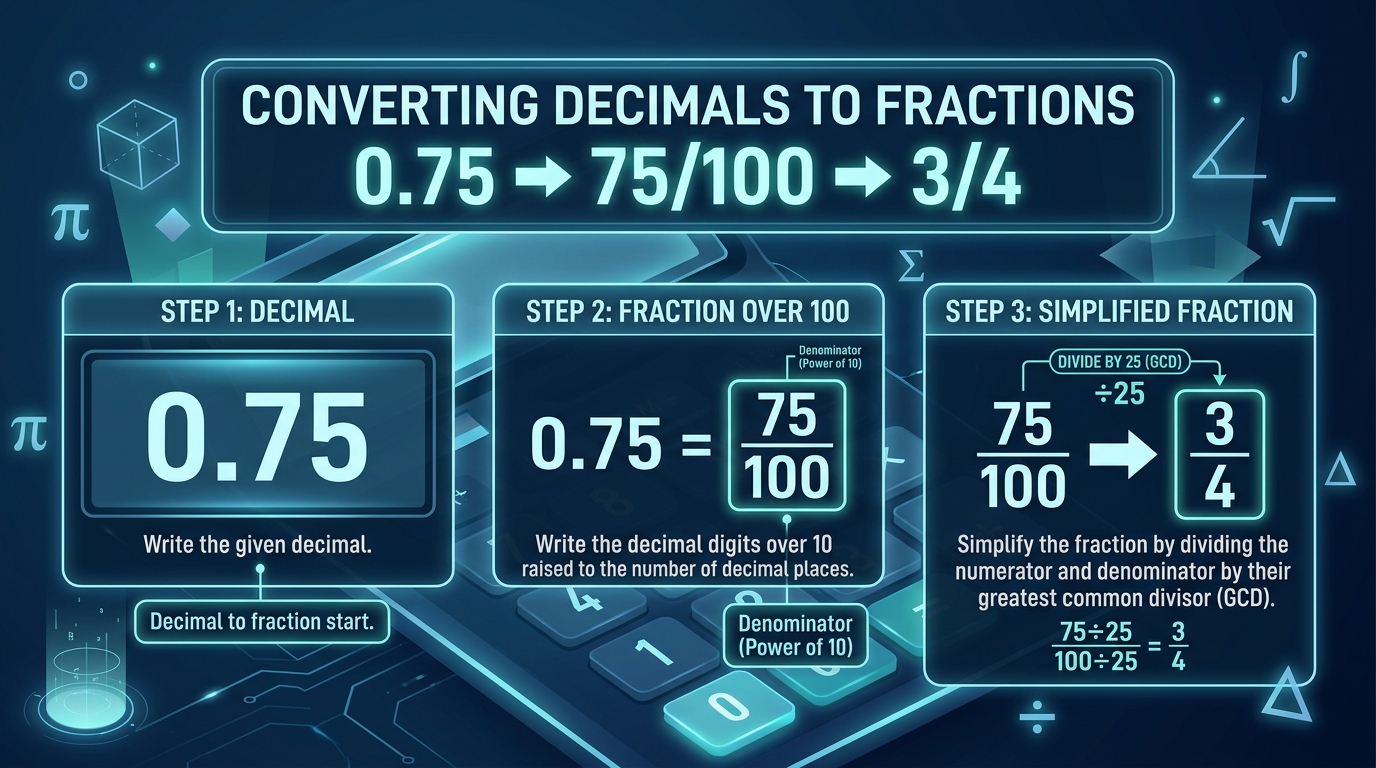
When converting a decimal to a fraction, the standard mathematical procedure is:
- Write the decimal as a fraction over a power of 10 (e.g., 10, 100, 1000).
- Remove the decimal point from the numerator.
- Simplify the fraction by dividing the numerator and denominator by their Greatest Common Factor (GCF / GCD).
Decimal Place Values
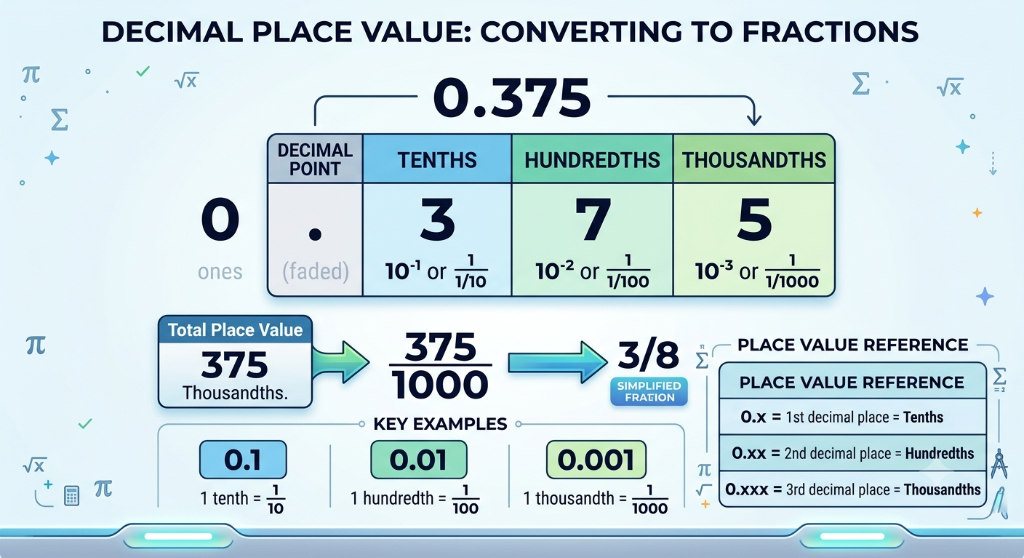
The denominator is determined by the place value of the furthest right digit after the decimal point:
| Decimal | Place Value Name | Power of 10 | Fraction Before Simplifying |
|---|---|---|---|
| 0.5 | Tenths | 10¹ = 10 | 5/10 |
| 0.25 | Hundredths | 10² = 100 | 25/100 |
| 0.125 | Thousandths | 10³ = 1000 | 125/1000 |
| 0.75 | Hundredths | 10² = 100 | 75/100 |
How to Convert Decimal to Fraction Step by Step
Step 1: Count the Digits After the Decimal Point
Start by counting how many places exist to the right of the decimal point. For example, in 0.75, there are 2 digits (7 and 5). Because there are 2 digits, your initial denominator is 10² = 100.
Step 2: Remove the Decimal Point
Write the digits without the decimal point directly into the numerator above the denominator found in Step 1. For 0.75, this produces the unsimplified fraction 75/100.
Step 3: Simplify the Fraction
Find the Greatest Common Divisor (GCD) of 75 and 100. The GCD is 25. Divide both top and bottom by 25:
100 ÷ 25 = 4
Result: 0.75 = ¾
If you have multi-fraction arithmetic to calculate, use our full Fraction Calculator to add, subtract, multiply, and divide with automatic reduction.
Examples of Converting Decimals to Fractions
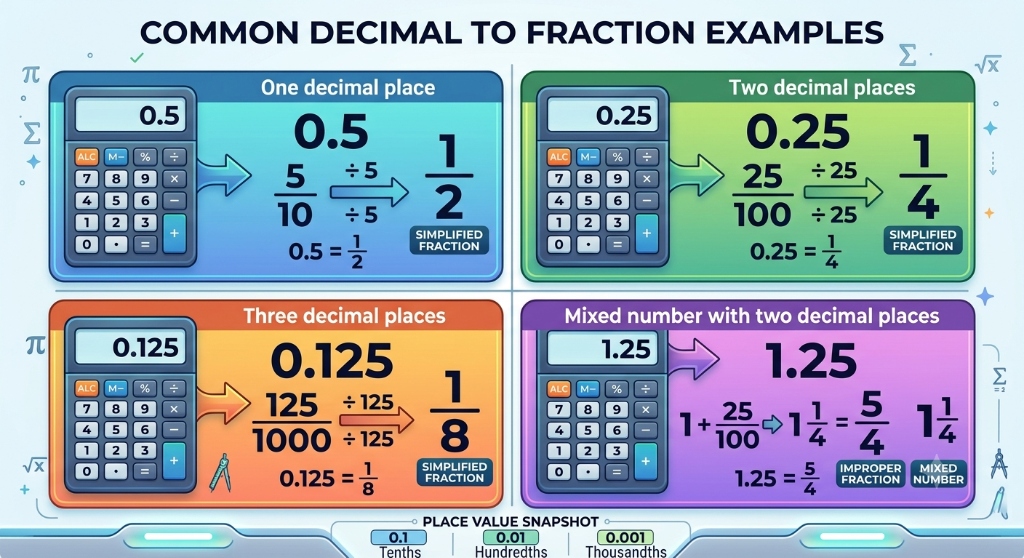
Example 1: Convert 0.5 to a Fraction
There is 1 digit after the decimal point:
Divide by 5 (GCD): 5/10 = ½
Example 2: Convert 0.25 to a Fraction
There are 2 digits after the decimal point:
Divide by 25 (GCD): 25/100 = ¼
Example 3: Convert 0.125 to a Fraction
There are 3 digits after the decimal point:
Divide by 125 (GCD): 125 ÷ 125 = 1, 1000 ÷ 125 = 8
Example 4: Convert 1.25 to a Fraction
Decimals greater than 1 can be expressed as improper fractions or mixed numbers:
Mixed number format: 1 ¼
How to Convert a Terminating Decimal to a Fraction
A terminating decimal is a decimal that ends after a finite number of digits. Common terminating decimals include 0.5, 0.25, 0.125, 0.75, 2.50, and 3.125.
The universal formula for terminating decimals is:
For instance, in 0.625, there are three decimal places:
Divide numerator and denominator by 125:
625 ÷ 125 = 5
1000 ÷ 125 = 8
Therefore, 0.625 = ⅝
How to Convert a Repeating Decimal to a Fraction
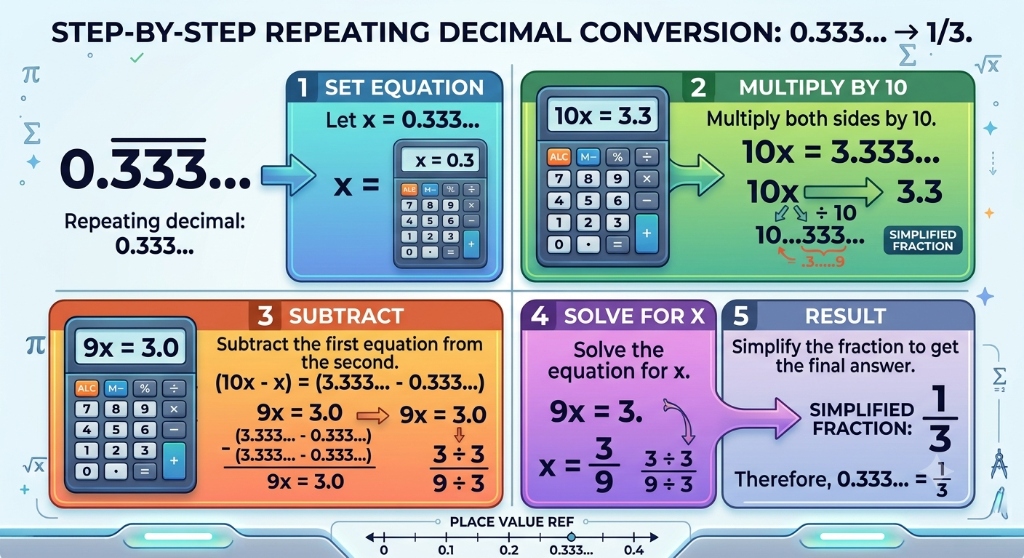
Repeating decimals (such as 0.333... or 0.666...) do not terminate. Writing 333/1000 is merely an approximation. To find the exact rational fraction, we use an algebraic system of linear equations.
Step-by-Step Proof for 0.333...
- Let
x = 0.333... - Multiply both sides by 10 (since 1 digit repeats):
10x = 3.333... - Subtract the original equation from the multiplied equation:10x - x = 3.333... - 0.333...
9x = 3 - Solve for x:
x = 3/9 - Simplify the fraction: x = ⅓
Another Repeating Decimal Example: 0.666...
Using the exact same subtraction technique:
10x = 6.666...
10x - x = 6.666... - 0.666...
9x = 6 → x = 6/9 = ⅔
When converting fractions back to decimals with our Fraction to Decimal Calculator, our engine automatically detects recurring periods and formats them with bar notation (e.g. 0.3̄).
Converting Negative Decimals & Trailing Zeros
Converting Negative Decimals
Negative decimals follow the identical conversion rules. Simply carry the minus sign through to the final answer:
Attach sign: -¾ (or -3/4)
Decimals with Trailing Zeros
Trailing zeros to the right of the decimal point do not change its value:
All three representations reduce to ½.
Common Mistakes to Avoid
For two decimal places like 0.45, the initial denominator must be 100 (45/100), not 10 (45/10).
Leaving 50/100 is mathematically valid, but standard academic and engineering forms require the irreducible fraction ½.
Always maintain negative signs during numerator division: -0.25 = -¼, not ¼.
Never round 0.333... to 333/1000. Use algebraic subtraction to reach the exact value ⅓.
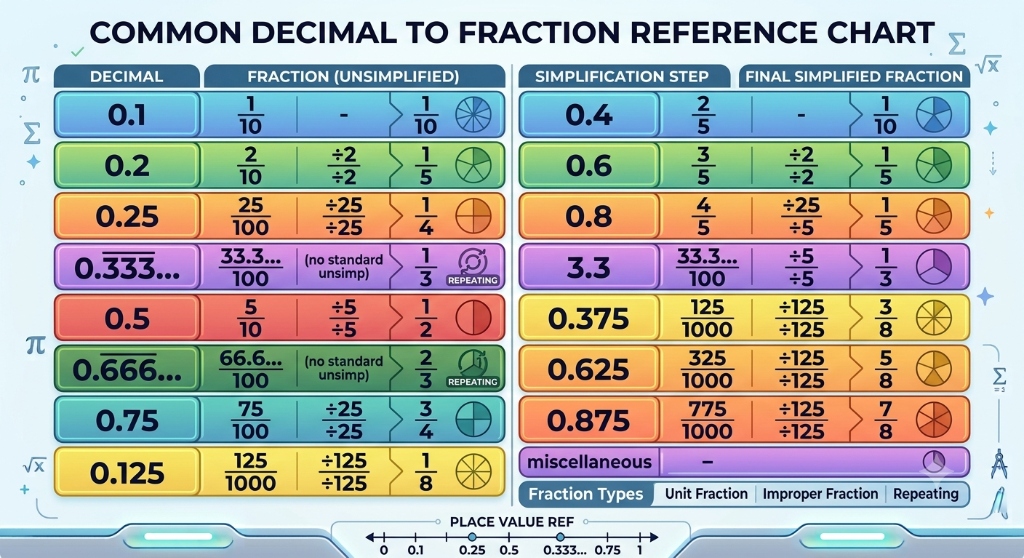
Quick Reference Table
| Decimal | Initial Fraction | GCD Divisor | Simplified Fraction |
|---|---|---|---|
| 0.5 | 5/10 | ÷ 5 | 1/2 |
| 0.25 | 25/100 | ÷ 25 | 1/4 |
| 0.75 | 75/100 | ÷ 25 | 3/4 |
| 0.125 | 125/1000 | ÷ 125 | 1/8 |
| 0.2 | 2/10 | ÷ 2 | 1/5 |
| 0.4 | 4/10 | ÷ 2 | 2/5 |
| 0.6 | 6/10 | ÷ 2 | 3/5 |
| 0.8 | 8/10 | ÷ 2 | 4/5 |
| 1.25 | 125/100 | ÷ 25 | 5/4 (1 ¼) |
| 2.5 | 25/10 | ÷ 5 | 5/2 (2 ½) |
Key Takeaways
- Converting a decimal to a fraction is a straightforward three-step process.
- Count the number of digits after the decimal point.
- Use 10, 100, 1,000, and so on as the initial power-of-10 denominator.
- Remove the decimal point to form the numerator.
- Always simplify by dividing by the Greatest Common Divisor (GCD).
- Repeating decimals require algebraic substitution (10x - x).
- Negative decimals preserve their minus sign in the fractional expression.
- Trailing zeros do not alter the numerical magnitude of a decimal.
FAQ: How to Convert Decimal to Fraction
Can every decimal be converted into a fraction?▼
Every terminating or repeating decimal is a rational number and can be expressed exactly as a fraction of two integers. Non-terminating, non-repeating decimals (like π = 3.14159... or √2) are irrational numbers and cannot be represented by a simple fraction.
What is 0.75 as a fraction?▼
0.75 = 75/100. When both numbers are divided by their greatest common divisor (25), the simplified fraction is ¾.
What is 0.5 as a fraction?▼
0.5 = 5/10. Dividing by 5 yields ½.
What is 0.333... as a fraction?▼
The infinite repeating decimal 0.333... equals exactly ⅓, solved via algebraic subtraction (10x - x = 3).
Conclusion & Related Mathematical Tools
Knowing how to convert decimal to fraction gives you a practical foundation for working with numbers in school, work, and everyday life. The process is especially easy for terminating decimals: write the decimal over the appropriate power of 10 and simplify.
Once you understand the basic method, you can also handle negative numbers, decimals greater than one, trailing zeros, and repeating decimals.
For quick calculations, our suite of specialized conversion engines is always available for instant verification:
Try a few examples yourself in the interactive calculator above, and share this guide with students, educators, and colleagues!