Step-by-Step Guide to Decimal Calculations: Master Decimals Without Confusing Mistakes
Master decimal arithmetic with crystal clarity. Discover foolproof methods for adding, subtracting, multiplying, dividing, rounding, and converting decimals into fractions and percentages with real-world examples.
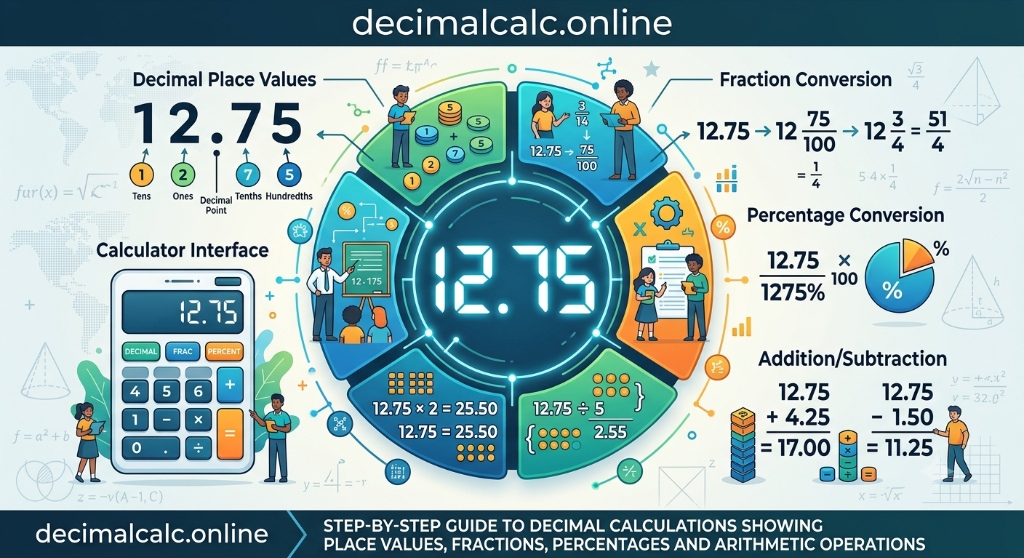
📑 Table of Contents
Introduction
Decimals are everywhere in our everyday life. You encounter them when checking price tags at grocery stores, calculating retail discounts, measuring workshop distances, tracking bank interest rates, reading medical statistics, or computing hourly payroll.
Yet even simple decimal math frequently trips up students and professionals alike. Misplacing a single decimal point, dropping trailing zeros, or rounding prematurely can lead to costly errors in finance, coding, and engineering.
The good news is that decimal calculations follow rigid, predictable mathematical rules. Once you grasp place values and basic alignment mechanisms, working with decimals becomes second nature.
What Is a Decimal Number?
A decimal number is a number that uses a decimal point (radix point) to represent parts of a whole based on powers of ten (base-10 system).
- 5.5 means five and one-half (5 1/2).
- 2.75 means two and seventy-five hundredths (2 75/100 = 2 3/4).
- 0.25 means twenty-five hundredths (25/100 = 1/4).
- 12.125 means twelve and one hundred twenty-five thousandths (12 125/1000 = 12 1/8).
The digits after the decimal point represent increasingly smaller fractional place values: tenths (10⁻¹), hundredths (10⁻²), thousandths (10⁻³), and ten-thousandths (10⁻⁴).
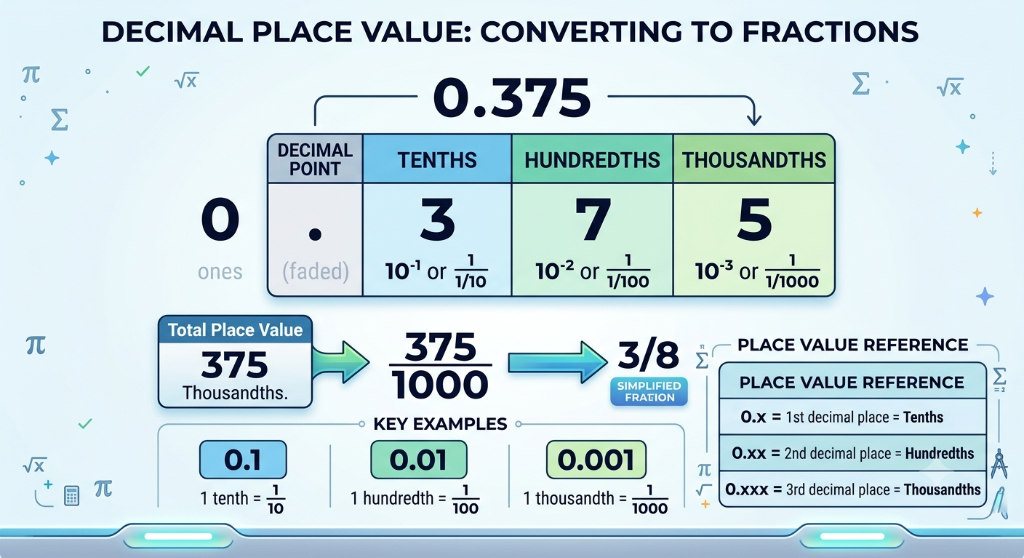
Decimal Place Value Breakdown: 37.428
| Digit | Place Value | Fractional Value | Exponential Form |
|---|---|---|---|
| 3 | Tens | 30 | 3 × 10¹ |
| 7 | Ones | 7 | 7 × 10⁰ |
| . | Decimal Point | Radix separator | Base 10 point |
| 4 | Tenths | 4/10 = 0.4 | 4 × 10⁻¹ |
| 2 | Hundredths | 2/100 = 0.02 | 2 × 10⁻² |
| 8 | Thousandths | 8/1000 = 0.008 | 8 × 10⁻³ |
1. How to Add Decimals
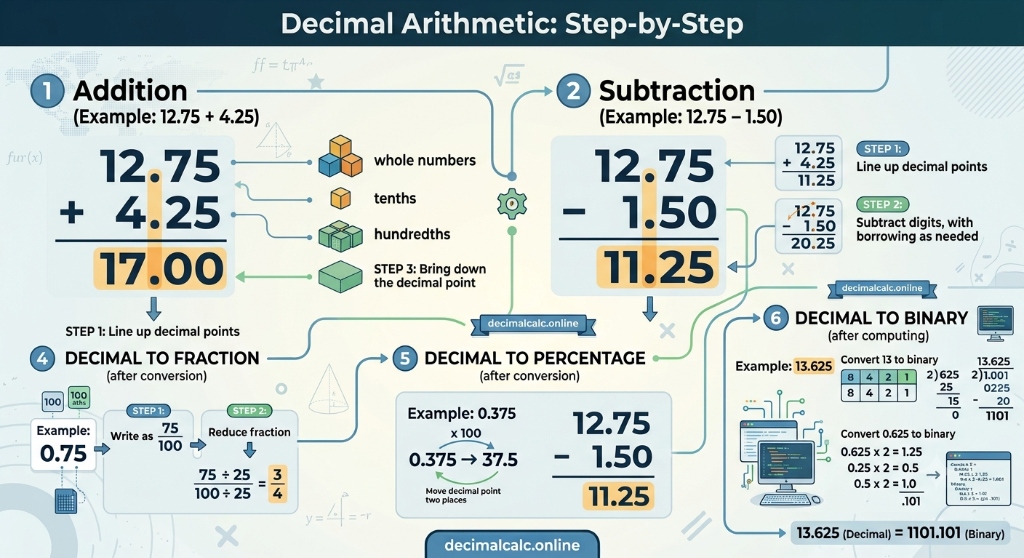
Adding decimals is straightforward when the decimal points are aligned vertically.
Example 1: Aligned Addition
Calculate: 12.45 + 3.72
  12.45
+  3.72
-------
  16.17
Result: 16.17
Example 2: Adding Trailing Zeros
Calculate: 12.5 + 3.75 (Pad with 0)
  12.50  ← (Padded with 0)
+  3.75
-------
  16.25
Result: 16.25
2. How to Subtract Decimals
The same vertical alignment rule applies when subtracting decimals. Align the decimal points first, borrow across columns where necessary, and bring down the decimal point.
Example: 15.80 − 6.35
  15.80
-  6.35
-------
   9.45
Result: 9.45
3. How to Multiply Decimals
Multiplying decimals does not require vertical decimal point alignment. Instead, follow this simple 2-step process:
- Multiply normally: Ignore the decimal points temporarily and multiply as if they were whole numbers.
- Count and place decimals: Count the total number of decimal places in all original factors combined, then place the decimal point that many places from the right of the answer.
Example 1: 2.5 × 1.2
1. Whole multiplication: 25 × 12 = 300
2. Decimal count: 1 + 1 = 2 places from right
3.00 = 3
Example 2: 3.25 × 2.4
1. Whole multiplication: 325 × 24 = 7,800
2. Decimal count: 2 + 1 = 3 places from right
7.800 = 7.8
4. How to Divide Decimals
When dividing with decimals, make the divisor a whole number by shifting its decimal point to the right. Then shift the dividend's decimal point by the exact same number of places.
Example: Calculate 12.6 ÷ 0.3
- Shift divisor 0.3 one place right → 3
- Shift dividend 12.6 one place right → 126
- Divide: 126 ÷ 3 = 42
Therefore: 12.6 ÷ 0.3 = 42
5. How to Compare Decimal Numbers
Comparing decimals becomes effortless when you pad numbers so they have the exact same number of decimal places:
Compare 0.7 and 0.65:
Write 0.7 as 0.70 and compare with 0.65.
0.70 > 0.65 ⇒ 0.7 > 0.65
Remember: Trailing zeros after the last significant decimal digit do not change mathematical value (0.5 = 0.50 = 0.500).
6. How to Round Decimal Numbers
Rounding is essential when a calculation produces more precision than needed. Use the standard mathematical rounding rule:
- Inspect the digit immediately to the right of your target rounding place.
- If that digit is 5 or greater, round the target digit up by 1.
- If that digit is 4 or less, leave the target digit unchanged.
Target is 4.73. Next digit is 6 (≥ 5).
4.736 → 4.74
Target is 8.24. Next digit is 3 (< 5).
8.243 → 8.24
7. Converting Decimals to Fractions
Every terminating decimal can be written as a fraction over a power of 10 and simplified to lowest terms using the Greatest Common Divisor (GCD).
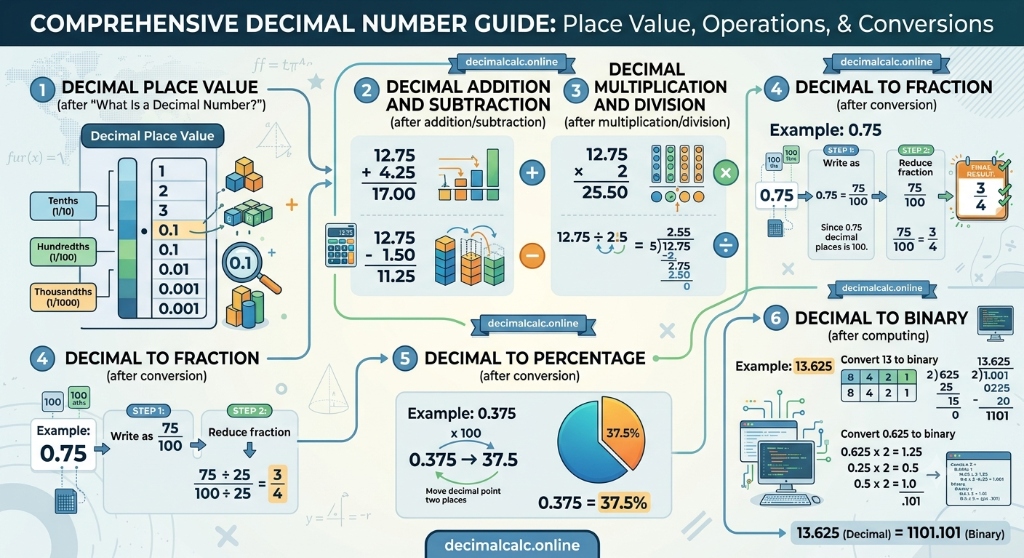
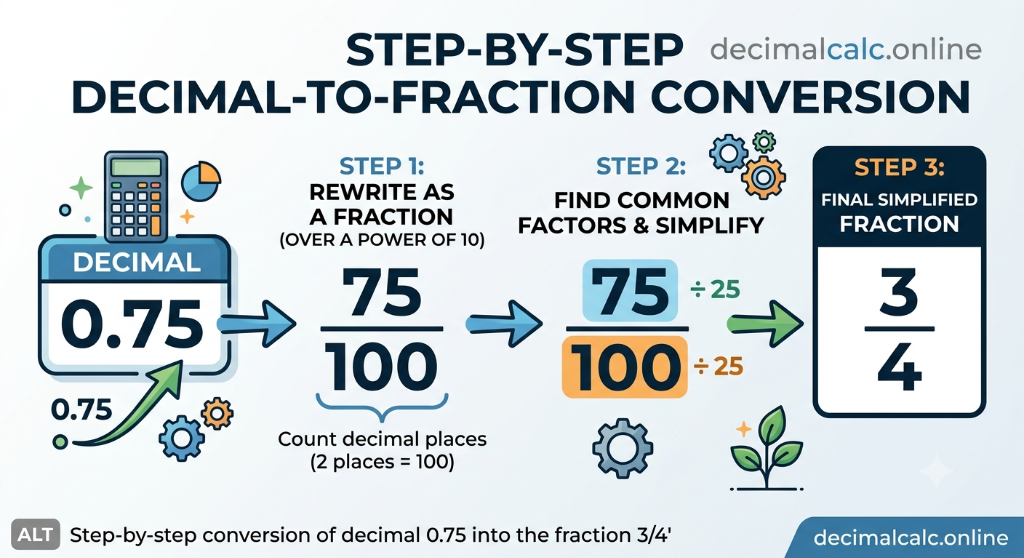
For instance, to convert a decimal to a fraction like 0.75:
- Write over 100 (since there are 2 decimal digits): 75/100
- Find GCD(75, 100) = 25
- Divide numerator and denominator by 25: (75 ÷ 25) / (100 ÷ 25) = 3/4
For repeating decimals like 0.333333... = 1/3 or 0.666666... = 2/3, our online Decimal to Fraction Calculator and Fraction Calculator automatically detect recurring periods and solve them with exact algebraic substitution.
8. Converting Decimals to Percentages
To convert decimals to percentages, simply multiply the decimal by 100 and append the percent symbol (%):
- 0.25 × 100 = 25%
- 0.375 × 100 = 37.5%
- 1.50 × 100 = 150%
Use our dedicated Decimal to Percent tool to instantly inspect financial basis points (bps), per mille (‰), and exact fraction equivalents with live visual gauges.
9. Converting Decimal Hours to Time
Decimal time arithmetic is crucial for payroll timesheets, billing, and project tracking. To convert decimal hours to time:
Example: 8.25 Hours
1. Whole hours: 8 hours
2. Fractional portion: 0.25 × 60 = 15 minutes
Result: 8 hours 15 minutes (08:15:00)
10. Decimal Calculations in Computing and Technology
Modern computers represent numbers internally using base-2 binary systems rather than base-10 decimals. For example, when you convert decimal numbers to binary:
Because certain base-10 fractions (like 0.1) have infinite repeating binary representations, software languages use IEEE 754 floating-point standards. Explore our Decimal to Binary and Decimal to Hexadecimal tools to examine 32-bit float structures, two's complement sign bits, and byte nibbles.
Decimal Calculations in the Real World
🛒 Shopping & Personal Finance
Sales tax, discounts, interest rates, mortgage amortizations, and grocery budgeting.
🏗️ Construction & Machining
Converting 3.75 inches into 3 3/4 inches, architectural blueprints, and metric calibration.
🔬 Science & Laboratory Measurements
Titration volumes, molar concentrations, physics kinematic rates, and temperature differentials.
📊 Business & Data Analysis
Profit margins, currency exchange rates, quarterly projections, and analytics metrics.
Common Decimal Calculation Mistakes
Never align numbers based on their rightmost digit alone when adding or subtracting. Always align vertically by the decimal point.
When multiplying, sum the decimal counts of all terms. When dividing, shift both divisor and dividend by the identical amount.
Rounding numbers at every intermediate step introduces compound rounding error. Maintain high precision throughout and round only the final quotient.
A calculator faithfully evaluates what you type, but typing a division sign instead of multiplication produces a valid result to the wrong problem. Always sanity check with mental estimation.
A Simple 5-Step Method for Checking Decimal Answers
Confirm +, −, ×, or ÷.
Verify point placement & zeros.
Round numbers mentally first.
Run manual or tool calculation.
Match result against estimate.
Key Takeaways: Decimal Calculation Mastery
- Decimals represent fractional parts of a whole using a base-10 place value structure.
- Always line up decimal points vertically for addition and subtraction.
- Count total decimal places when placing the decimal point in multiplication answers.
- In division, shift the divisor's decimal point to form a whole number, shifting the dividend equally.
- Use Decimal to Fraction and Fraction Calculator to verify results with step-by-step mathematical proofs.
Frequently Asked Questions (FAQ)
What is the easiest way to calculate decimals?
Start by identifying the operation and place values. For addition and subtraction, align the decimal points vertically. For multiplication, multiply the numbers normally as whole numbers first, then count and insert the total number of decimal places from the right.
How do you add decimals correctly?
Write the numbers so their decimal points are vertically aligned. Pad shorter decimal numbers with trailing zeros where necessary (e.g. 12.5 becomes 12.50), then perform normal addition column by column.
How do you convert a decimal into a fraction?
Write the decimal as a fraction over a power of 10 (10, 100, 1,000, etc.) depending on the number of decimal places, then reduce the fraction to lowest terms using the Greatest Common Divisor (GCD). For example: 0.75 = 75/100 = 3/4.
Can a decimal be converted into a percentage?
Yes. Multiply the decimal number by 100 (or shift the decimal point two places to the right) and append the percent sign (%). For example: 0.625 × 100 = 62.5%.
Have a Decimal Calculation to Verify?
Explore our suite of high-precision math calculators with instant step-by-step proofs, GCD reductions, and radix representations.